
People who are close to me know that I’m a big advocate for tracking your expenses. I got interested in the idea early 2015, because not knowing where i spent my money has been and my guess is will always be a pet peeve of mine, but I never had the discipline to do it up until July last year when I started working. The end of this year marks the first year I’ve tracked 100% of my income and expenses1. I’d like to share some of the things I learned and hopefully convince you to do the same or at least start thinking about money differently.
The importance of budgeting
Much like task management systems, there are a ton of ways you can budget your expenses, the envelope system, the 50/30/20 rule, reverse budgeting, YNAB. I’ll probably do a whole separate blog post on this someday but I think the key thing to keep in mind for every budgeting methodology is that you have to be completely honest with yourself in terms of your expected spending and income/savings, and also know that you probably have to make a few tweaks after looking at your actual expenses 3-4 months down the road. A personal example I have is that when I first budgeted my monthly expenses, I set the amount I was going to spend on food2 every month to 800. After about 4 months I realised that it was completely unrealistic because I was spending about 1000 or a little over 1000 every month on food alone.
The thing with money is that you have a finite amount of it but infinite ways to spend it, so the fact that I was spending more of my resources on food meant that I either had to spend less on something else, be it entertainment/clothes/hobbies, or it meant dipping into my savings, or the logical step which is to simply spend less on food altogether. I’m not gonna tell you to buy a crockpot and start cooking your own meal (though that’s certainly a good way save money on food), because ultimately it’s your money and you get to decide how to spend it. The point isn’t to force you to live a certain way, but to own up to the way you choose to live and be realistic with your expectations.
Seasonal Expenses
The mistake most people make is not taking into account recurring expenses, or as I’d like to call them, seasonal expenses. It refers to expenses that come and go, much like the seasons. For example car insurance, road tax, quick rent, medical check-ups, PS plus subscription fees, gym membership fees, the list goes on and on. Failure to account for them in your budget is a recipe for disaster, you can probably recall the times when you thought that you were doing well in terms of saving only to be hit with the annual car insurance payment which costs 1000, then 2 months later you realise the tread on your tyres have gone bald, and that’ll cost you another 800. To account for this, I’ve listed down all my seasonal expenses and I calculated the monthly average expected to be spent, and every month I set aside the money by transferring it into a another account in pocket expense. This is super effective because by doing that you get a realistic representation of your actual disposable income. The balance you see in your bank account isn’t all available for spending.
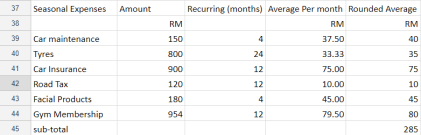
The spreadsheet I used to compute the amount I have to set aside every month
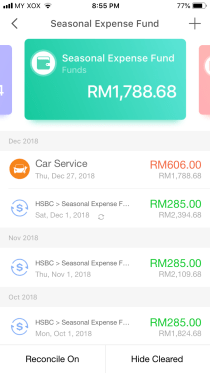
A separate account in pocket expense I created, I’ve set up a recurring transfer so that 285 is transferred into the account monthly.
Breaking it down
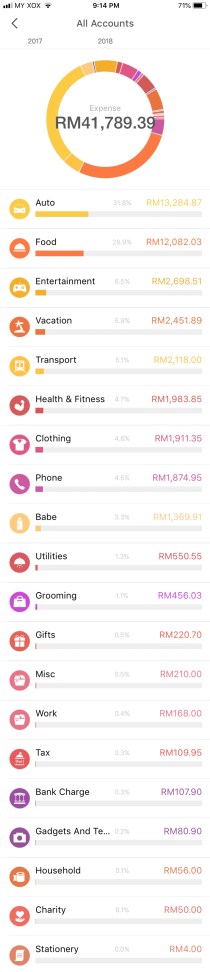
For obvious reasons I will not be disclosing my income but I’m ok with showing my expenses. I spent a total of 41k this year, and boy was that hard to say, but this is reality. As expected, the 2 major categories that account up to 60% of my expenses are food and car expenses. I would also like to say that it’s incredibly ironic because I spent more on my car than I did on food this year.
I just want to point out that unlike some of my colleagues, I’m lucky in the sense that I don’t have to pay for rent which could account for 20-30% of your income depending on where you choose to stay relative to how much you earn. I also don’t have student loans that I have to repay. My only real commitment is the installment for my 14 year old Vios which I bought from a relative early last year. And I know that some people reading this don’t even have to deal with that because their parents have already paid off their car, that’s great news for you and please consider yourself very very lucky because I know fresh graduates that aren’t from KL and are therefore renting, repaying PTPTN loans, and are paying monthly installments for their car. These 3 things alone makes a world of difference in disposable income between 2 fresh graduates earning 3k a month (1.2-1.5k by my estimates). The fact that two people earning the same amount of money will end up having a disparity in disposable income of 1+k means that they will ultimately lead very different lives. Therefore my opinion is that there is no use trying to compare with your peers because everyone has different obligations, and if you are the person with a mountain of debt you get discouraged pretty quickly. The only person that you should compare yourself to is yourself. Know where you stand, look at where you want to be, and keep moving towards it.
I don’t think it’s possible to cut down on car expenses because most of it are unavoidable costs (installment, parking spot rental, petrol, general maintenance). The one place that I can definitely cut down on is food, getting into the habit of meal prepping will help, and perhaps choosing cheaper options rather than expensive restaurants when going out for lunch with colleagues. But honestly a big chunk of it is attributed to paying for weekly family dinners, reunion dinners or birthday meals which really adds up because these places aren’t cheap. Overall I think it’s possible to bring it to a little under 10k. In terms of savings, I’m actually doing better than what I initially budgeted, probably because I have other sources of income other than my full time job. I wouldn’t be able to save nearly as much if I didn’t have that and continued my current lifestyle, which got me wondering if I should live as though I don’t have these extra sources because ultimately I won’t be able to sustain this forever. That’s something i will have to think about but overall i’m very satisfied with how I’m doing. If everything goes according to plan by the end of next year i would have saved enough to down pay a condo.
Summing it up
I personally use pocket expense3 to track my expenses, it’s an app i find to be most suited for my needs, but any other app is fine as long it keeps you consistent. Don’t fall into the analysis paralysis trap and overthink this, just pick one and go with it. In terms of budgeting methodologies, i don’t adhere to a particular one but I’ll link a few good places to start and a few rule of thumbs to keep in mind below. I hope to do a more extensive version of this somewhere down the line where I breakdown my thoughts and line of thinking, but for now, I wish every one a happy new year, here’s to a better 2019.
Links:
 Life of a Ken